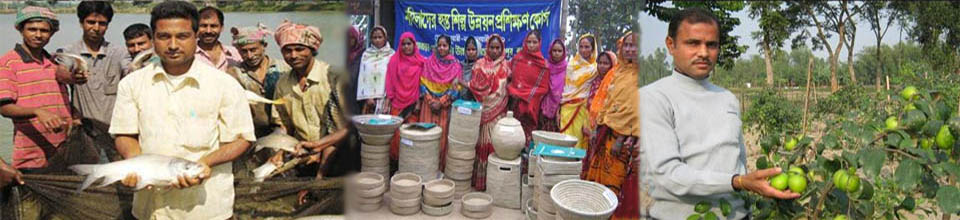
| 1. Bangladesh Rural Development Board ( BRDB ) Pallibhaban-5, Kawran bazar, Dhaka, Bangladesh. Fax No: +8802-8114343, Telephone No: +8802-9115376, PABX-9140399-403 Webpage:http://www.brdb.gov.bd/ 2. Department of Cooperatives ( DOC ) Samabaya Bhaban, F-10, Agargaon Civic Sector, Shere Bangla Nagar Dhaka-1207, Bangladesh. Telephone No: +8802-9141131, Fax No: +8802-9136595, e-mail: coop_bangladesh @ yahoo.com, Webpage: http://www.coop.gov.bd/ 3. Bangladesh Academy for Rural Development ( BARD ) Kotbari , Comilla-3503 , Bangladesh. Fax No: +88081-68406, Telephone No: + 88081-76424-8(PABX), +88081 63600 Webpage: http://www.bard.gov.bd/ 4. Rural Development Academy ( RDA ) Sherpur, Bogra-5842, Bangladesh. Telephone No: PABX: + 88 051-51001, 78601-2, + 88 051-78603, Fax No: +880821-4451659, Webpage: http://www.rda.gov.bd/ 5. Training Institutes/Centres Bangladesh Rural Development Board ( BRDB ) Bangladesh Rural Development Board (BRDB) has been working as the biggest agency responsible for operation of micro-credit program as well as social mobilization work. The priorities and strategies of BRDB include a) improving the access of the rural poor, particularly women to productive resources through social mobilization, training, special credit programs and rural institution building, b) support for off-farm domestic capital formation. The Comilla cooperative based organisational structure of the 1960s named COMILLA DISTRICT INTEGRATED RURAL DEVELOPMENT PROGRAMME (CDIRDP), has undergone an evolutionary phase of development through INTEGRATED RURAL DEVELOPMENT PROGRAMME (IRDP) in the 1970s, reaching its current status and got the recognition as a body named BRDB. IRDP was transformed into BRDB in 1980s through an ordinance. BRDB is an autonomous institution, governed by a Board of Governors of which the Minister for Local Government, Rural Development and Cooperatives is the Chairperson. BRDB has achieved success in organising woman and male members of the cooperatives/non-formal groups, creating their own capital through mobilising their small savings, supply of irrigation equipments, training on modern agricultural cultivation and making provision for agricultural and small credit. The Board has taken a pioneering role in initiating self-employment projects through training on income generation activities. It has also promoted the cause of poverty reduction and rural development by taking up or supporting family planning, adult literacy, women’s empowerment through ensuring their rights, tree plantation and nursery, improved hearth, physical infrastructure development and such other projects. Learn more Department of Cooperatives ( DOC ) Cooperative movement is active in this part of the globe for over a century in a varying texture of its operation. The focus of the movement is socio-economic development through employment generation and poverty alleviation. The Department of Cooperative (DOC) is the principal government organization responsible for the promotion & development of cooperative societies in Bangladesh. The DOC works directly under the supervision and control of the Rural Development & Cooperative Division (RDCD) of the Ministry of Local Government, Rural Development & Cooperatives. Broadly, DOC carries out the following responsibilities and functions, - registration of cooperative societies, - undertake annual audit of cooperative societies, - formulate policies pertaining to administration and management of cooperative movement and keep it updated with the changing expressed needs of the stakeholders, - ensure compliance of cooperative rules and regulations, - administration of DOC, - organise regular training courses for the officers and employees of the Directorate, cooperative society members and salaried personnel, - collate, preserve data on cooperatives and publish them, - plan and direct promotional, publication and expansion programmes on cooperatives, - formulate and implement development plans and projects with the approval of the government . There are 150,964 registered cooperative societies in the country (June 2005), out of those 21 are national societies, 1,086 central societies, and 149,857 primary societies. The number of members of primary societies is 7,791,328. These societies have created a fund under different categories amounting to Taka 1064 crore (June 2005). During the same period the amount of effective capital of these societies stood at Taka 3,175 crore. The DOC is headed by a Registrar, who is a civil servant not below the rank of a Joint Secretary to the Government of Bangladesh. There are four Additional Registers below the Registrar. There are four Divisional Cooperative offices (at Dhaka, Chittagong, Rajshahi and Khulna) throughout the country. Each of these offices is headed by a Divisional Joint Registrar. There are sixty four District Cooperative Offices throughout the country. Each of the districts is headed by a District Cooperative Officer, who is the registering authority of all Primary Cooperative Societies under that district. Furthermore, there are cooperative offices at each of the 479 Upazilas throughout the country. There is a National Cooperative Academy and 9 (nine) Cooperative Zonal Training Institutes under the DOC at various locations of the country. Learn more Bangladesh Academy for Rural Development ( BARD ) Bangladesh Academy for Rural Development (BARD) was established, initially, to train the personnel of V-AID (Village – Agricultural and Industrial Development) Programme in 1959 by the then -government at Comilla. Gradually, through its epoch-making action research and research activities in the field of rural development, BARD has earned its name and fame nationally and internationally. The model of rural development that BARD came up with its known - Comilla Model or Comilla Approach (CA) of rural development. CA consists of main four components: Rural Works Programme (RWP), Thana Irrigation Programme (TIP), Two-tier Cooperatives and coordinated rural governance system, that was initially named TTDC (Thana Training and Development Centre). Since its inception in 1959, BARD has been taking up valuable role in formulation and/or revision of national rural development policy based on empirical data derived through research and action research and received National Award in 1986 for its remarkable contribution in Rural Development BARD is working relentlessly providing expert human resources for rural development through its training courses. It is enabling various national, international research institutes and entrepreneurs conduct research and training, organise seminar, workshop and open discussion through sharing its years of professional experience. BARD is contributing immensely for rural development by adding continuously experimenting with development paradigms and coming up with successful models e.g. Bangladesh Academy for Rural Development (BARD) is located at Kotbari, a rural area along the Mainamati-Lalmai (one of the archeological sites of Bangladesh) hill range in Comilla district. It is about 100 kilometers away from the capital city of Dhaka. The sprawling campus covers an area of 156 acres of land including undulating hilly terrain and valleys. It is an autonomous institution governed by a Board of Governors(BoG) of which the Minister for Local Government, Rural Development and Cooperatives is the Chairperson. Administratively, it is attached to the Rural Development and Cooperatives Division. The activities of the Academy carry out by its Faculty working in 9 Divisions, each of which is headed by a Director. The Divisions are divided into two broad categories: Service Divisions and Academic Divisions. The Service Divisions include Training; Research; Project; and Administration. The Academic Divisions are Rural Administration and Local Government; Rural Economics and Management; Rural Education and Social Development; Rural Sociology and Demography; and Agriculture and Environment. Learn more Rural Development Academy ( RDA ), Bogra Rural Development Academy (RDA), Bogra, was established in June 1974 as a specialised national institution for providing training, undertaking research for generation of innovative ideas, feed policy formulation, and undertaking action research for evolving new generation of development paradigms. Over its existence of more than three decades, RDA has been able to create some path breaking innovations and a competent cadre of professionals in the field of rural development. As recognition of its contribution in the field of rural development, RDA has been awarded nationally and internationally. RDA achieved the much-coveted ‘Swadhinata Padak’(Independence Award) in 2004, for the extra-ordinary contribution in rural development. It also received International Communication Award 2004, from IVCA London, for developing effective rural communication model. Some of the more recognised and recorded models of RDA are: - irrigation command area development through buried pipe, innovation of multi-purpose use of low cost DTW, - development of arsenic-free safe water supply plant, creation of additional employment, - increase in marginal productivity of labour in rural economic activities and poverty alleviation through irrigation and water management, development of technical protocol for commercial hybrid maize seed production in Bangladesh, - women-led seed business project , - water saving technology for rice cultivation, and - Comprehensive Village Development Programme (CVDP) along with BARD and DoC. RDA is an autonomous institution and its governing body is the Board of Governors (BoG) headed by the Honourable Advisor/Minister in-charge of Local Government, Rural Development and Cooperatives (LGRD&C). As a linkage to the Government of Bangladesh, RDA is within the administrative jurisdiction of the Rural Development and Cooperatives Division (RDCD) of the Ministry of LGRD & C. Learn more TRAINING INSTITUTES/CENTRES Besides BARD, Comilla and RDA, Bogra, there are some other training institutes and centers, which are providing training to the cooperators of different societies and beneficiaries of different projects. Some of the training institutes/centres are under the administrative control of BRDB and some are under the Department of Cooperatives (DOC). The names of the training institutes/centres are as follows: |